The Giant Misunderstanding
A Tale of Gorgok the Blue-Skinned Giant
5/8/202420 min read
Chapter One: The Cave of Odd Treasures
* * *
Deep in the Ozark hills of northern Arkansas, tucked beneath a bluff so overgrown with kudzu that even the deer had given up on it, there lived a giant named Gorgok. On a good day he stood twelve feet tall, thirteen if he’d slept well and remembered to stretch, and his skin ran the color of a summer blueberry, right down to the dusty finish. Two harvest moons served as his eyes, enormous and golden. Teeth the approximate size and shape of piano keys filled his mouth, though they were considerably less musical.
Gorgok’s cave could have served as a museum of disorganization. Over the centuries (he’d lost count somewhere around his four-hundredth birthday and stopped trying), he had accumulated a staggering collection of trinkets, salvage, and what most reasonable people would call junk. Hubcaps from every decade since the 1940s leaned against one wall, stacked like silver pancakes. A pile of mismatched shoes rose to the ceiling in one corner. He’d always meant to sort them into pairs. An entire canoe sat wedged between two stalagmites, and next to it, a vintage jukebox that played one song: “You Ain’t Nothin’ But a Hound Dog,” which Gorgok considered the pinnacle of human musical achievement.
But Gorgok was, above all things, gentle. Sunsets made him cry. Rocks got an apology when he tripped over them. Once, he’d spent three days trying to help a confused turtle find its way to a pond, only to discover the turtle had been heading in the right direction the entire time and he’d been leading it in circles.
Of all the treasures, his favorite was his drinking glass. Well, to a human it would have been a fishbowl, but to Gorgok it served as a tumbler. Thirty years ago, he’d found it at a yard sale, watching from behind a barn, waiting until everyone left, then placing a handful of quartz crystals on the table as payment. That glass had held thousands of sips of spring water, until last Tuesday, when he’d been practicing what he called “dancing.” The dancing registered 2.3 on the Richter scale in Little Rock. It also knocked the glass clean off his stone shelf.
The glass shattered into approximately one million pieces, each one catching the cave’s bioluminescent glow. Gorgok stood over the wreckage. His enormous lower lip puckered and shook.
“My glass,” he said, at a volume roughly equal to a riding lawn mower. “My beautiful, beautiful glass.”
Pine sap wouldn’t hold the pieces together. Willing them to fuse didn’t work. Neither did asking nicely. And so, for the first time in decades, Gorgok decided he would have to leave his cave and walk to the nearby town of Hardy, Arkansas, to find a replacement.
Hardy was a small town, the kind of place where everyone knew everyone else’s business, where the local diner served gossip alongside its biscuits and gravy, and where the biggest excitement in recent memory had been when Old Dale Hutchins’ prize rooster escaped and turned up three days later roosting on top of the Methodist church steeple, crowing at passing airplanes as if challenging them to a duel.
Hardy was not ready for a twelve-foot blue giant.
Chapter Two: Gorgok’s Exit from the Cave
* * *
The cave entrance did not accommodate a creature of Gorgok’s dimensions. It had never been asked to. The opening stood roughly eight feet high and four feet wide, a natural formation that had existed for millions of years without once considering the possibility that a twelve-foot giant might want to use it as a front door. Gorgok had to perform what he called “the Squeeze.”
The Squeeze involved turning sideways, ducking down, sucking in his considerable belly, and shuffling forward while making a sound like a balloon deflating.
“Almost . . . oof . . . there . . .” Gorgok said through his teeth, his left shoulder scraping against the limestone. His right hand reached out for something to hold onto and found a stalactite that had been hanging for sixty thousand years. It snapped off with a crack that echoed through the cave like a gunshot.
He stared at the broken stalactite in his hand. “Sorry about that,” he said to the cave ceiling, because apologizing to geological formations was just what Gorgok did.
But the stalactite’s absence started a chain reaction. Without its anchoring weight, a thin shelf of limestone above the entrance shifted. Pebbles rained down. Then rocks. Then what could be described as a minor landslide and what Gorgok would later call “a little dusty.”
He burst through the cave entrance in a cloud of grit and debris, stumbling forward with all the grace of a refrigerator falling down a flight of stairs. One foot caught on a root. Both arms pinwheeled, each one the length of a full-grown man, before he caught his balance against an oak tree. The oak groaned but held.
“Phew,” Gorgok said, brushing limestone dust from his shoulders. Cascades of gravel poured from his hair, which had the color and texture of Spanish moss.
Outside, the world was blinding. He’d forgotten how bright it got. The sky ran a shade of blue that felt competitive with his own skin tone. Trees were green, aggressively green, shamelessly green, as if they had something to prove. And the air smelled like pine needles and warm dirt.
Gorgok took a deep breath and sneezed. The sneeze sounded like a small cannon firing and sent a flock of starlings scattering from a nearby tree in a panic of wings and indignant chirping.
“Beautiful,” he said, wiping his nose with a hand the size of a dinner platter. “Just beautiful.”
From his vantage point on the hillside, he could see Hardy below: a cluster of buildings in the valley, rooftops glinting in the morning sun. The Spring River curved through the ground like a silver ribbon, and somewhere down there, Gorgok believed, he’d find a glass big enough for his hand.
He set off down the hill with tremendous enthusiasm and no coordination. Each step covered roughly six feet of ground and left an impression in the earth that would later be discovered by a local Boy Scout troop and reported as evidence of Bigfoot, generating three weeks of excited media coverage and a disappointing episode of a cable TV show about cryptids.
Branches snapped. Saplings bent. A family of squirrels watched from a safe distance with expressions that could best be described as concerned.
“Don’t worry, little friends!” Gorgok called, waving one enormous hand. The wave generated enough wind to send a pile of dead leaves swirling into the air. “I’m going to town! To get a glass! It’s going to be great!”
The squirrels did not look reassured.
Chapter Three: First Encounter, The Welcome Sign
* * *
The first indication that Hardy, Arkansas, was about to have an unusual day came in the form of a road sign. It stood at the edge of town, painted in cheerful red and white letters: WELCOME TO HARDY. WHERE EVERYBODY IS SOMEBODY!
Gorgok stopped in front of it. Golden eyes widened to the approximate diameter of salad plates. He read the sign once, then twice, then a third time, his lips moving with each word. A grin spread across his face, an enormous piano-key grin that could have been spotted from orbit.
“A welcome party!” he said, clapping his hands together. The resulting thunderclap startled a dog three blocks away into a barking frenzy. “For me! They knew I was coming! How thoughtful!”
The phrase “Where Everybody Is Somebody” moved him most. He interpreted it as a direct and personal message assuring him that even a blue-skinned cave-dwelling giant counted as a “somebody” in this town. The nicest thing anyone had ever said to him, and he hadn’t even arrived yet.
Gorgok straightened to his full height, smoothed down his hair (a futile gesture, like trying to tame a hedge with a comb), and strode toward town with the confident gait of a party guest who was certain he was both expected and fashionably late.
The first person to see him was Doreen Buckley, seventy-three years old, watering her petunias on Main Street. Doreen had lived in Hardy her entire life and believed she had seen everything there was to see. She had been wrong.
“Sweet mother of pearl,” Doreen said, dropping her garden hose. The hose, now unsupervised, began watering her shoes, but Doreen didn’t notice. She was staring at the twelve-foot blue creature ambling down the middle of the road with a smile that was expecting cake.
Gorgok waved at her. “Hello! Is this the party? I’m here for the party! The sign said I was welcome!”
Doreen screamed. The scream had such purity and volume that it could have shattered the glass Gorgok was looking for, had he already found it. She turned and ran toward her house with a speed that surprised both her and her orthopedist.
“JERRY!” she screamed, bursting through her front door. “JERRY, THERE’S AN ALIEN ON MAIN STREET!”
Jerry Buckley had been eating a ham sandwich and watching a fishing show. He looked up with the calm of a man who had been married to Doreen for fifty-one years and had learned that not every emergency qualified as an actual emergency.
“Doreen, honey, last time you said there was an alien, it turned out to be Dale Hutchins in that green poncho.”
“THIS ONE IS BLUE, JERRY! BLUE AND TWELVE FEET TALL!”
Jerry set down his sandwich. That was a new detail.
Within minutes, word spread through Hardy with the speed and efficiency that only small-town gossip networks can achieve. Phone lines buzzed. Text messages flew. Mabel at the post office told Frank at the hardware store, who told his wife Linda, who called her sister in Ash Flat, who called the local radio station, which put out an emergency broadcast so garbled and confused that listeners were left with the impression Hardy was being invaded by either aliens, a circus, or both.
Gorgok, obliviously, continued down Main Street, looking for something that resembled a party.
Chapter Four: The Coffee Shop Confusion
* * *
The Spring River Brew was Hardy’s only coffee shop: exposed brick walls, mismatched furniture, and a chalkboard menu that changed daily based on the owner’s mood and what ingredients hadn’t expired. Tammy Nguyen, thirty-five, had moved to Hardy from Little Rock five years ago looking for “a simpler life” and had instead found a life that was simple in all the wrong ways and complicated in all the unexpected ones.
Tammy was behind the counter, explaining to old Mr. Henderson for the fifth time that week that they did not serve sweet tea, when the front door opened. Or rather, the front door frame opened, because Gorgok couldn’t fit through the door itself. He managed to get his head and one shoulder through the opening before becoming stuck.
“Hello!” he called from the doorframe, his voice rattling the coffee mugs on their hooks. “I’m looking for a glass!”
The five customers inside the Spring River Brew reacted with varying degrees of alarm. Mr. Henderson dropped his decaf. A college student visiting for a canoe trip took a photo, then another, then started a livestream. Two women at a corner table grabbed each other’s hands and began praying. The fifth customer, a man named Doug who worked at the bait shop and had seen some things in his day, took another sip of his coffee and said, “Huh.”
Tammy defaulted to customer service training. “Welcome to Spring River Brew,” she said, her voice shaking only a little. “Can I . . . can I help you?”
“Yes!” Gorgok said, wriggling his free arm through the door. “I need a glass. A big one. I broke mine, you see. It was an accident. I was dancing.” He paused. “I’m Gorgok.”
Tammy blinked. “We . . . we don’t sell glasses. We’re a coffee shop. We sell coffee.”
Gorgok’s brow furrowed, creating geological formations on his forehead. “Coffee,” he repeated, letting the word sit on his tongue. He had never heard it before. In his cave, he drank spring water, sometimes supplemented with what he called “rock juice”: water that had filtered through limestone and tasted like licking a clean pebble. “Is coffee a type of glass?”
“No, it’s a . . . it’s a drink. A hot drink. Made from beans.”
“Beans!” Gorgok perked up. He knew what beans were. He’d eaten beans before, though he preferred them raw and by the handful, which would have horrified any nutritionist. “Bean water! In a glass!”
“In a cup, usually . . .”
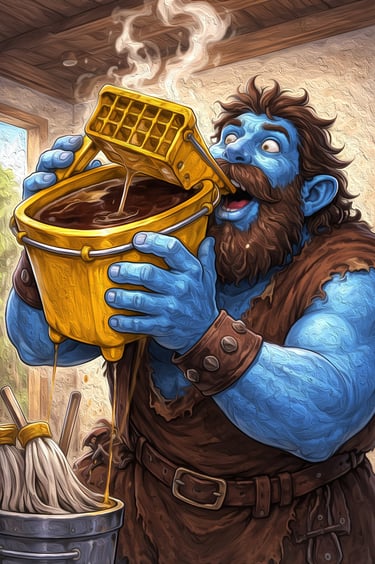
“Do you have a big cup? The biggest cup? A cup the size of . . .” He looked around for a reference point. “. . . the size of that bucket?” He pointed at Tammy’s mop bucket in the corner.
Tammy looked at the mop bucket. She looked at the enormous blue face wedged in her doorframe. Her sense of what constituted a normal Tuesday morning loosened a notch.
“Our largest size is the Big Muddy. It’s twenty ounces.”
Gorgok had no concept of ounces, but twenty of anything sounded promising. “Yes! The Big Muddy! I’ll take one!”
Tammy made the coffee on autopilot, her hands going through the familiar motions while her brain tried to process the fact that she was serving a latte to a creature that appeared to have been assembled from a blueberry and a mountain. She handed the cup to the enormous blue hand reaching through the doorway.
Gorgok held the Big Muddy between his thumb and forefinger. It looked like a thimble in his grip. He peered at it with one enormous golden eye, like a jeweler examining a suspect diamond.
“This,” he said, “is small.”
“It’s our biggest size,” Tammy said.
Gorgok tipped the entire twenty ounces into his mouth. He smacked his lips. His eyes widened. His pupils dilated to the size of silver dollars. His fingers began to tremble.
“WHAT IS THIS MAGIC BEAN WATER?” he said at a volume that set the ceiling fan wobbling. “IT’S INCREDIBLE! IT’S LIKE LIGHTNING IN MY MOUTH! MY BRAIN IS TINGLING! EVERYTHING IS BEAUTIFUL AND FAST!”
He had just experienced caffeine for the first time in his four-hundred-and-something years of existence, and his nervous system responded with the enthusiasm of a system that had never been asked to process a stimulant before.
“I NEED MORE!” Gorgok said, his eyes wild, his free hand drumming on the exterior wall at a speed that knocked the “Open” sign off its hook. “TEN MORE! TWENTY MORE! MAKE ME A BIG MUDDY THE SIZE OF MY HEAD!”
“We don’t have a cup that . . .”
“USE THE BUCKET!”
Doug, at his corner table, took another sip of coffee. “Reckon he’s never had espresso,” he said to no one in particular. “Gonna be a long day.”
Chapter Five: The Glass Store Misinterpretation
* * *
After consuming what Tammy estimated was roughly two gallons of coffee brewed into her mop bucket (which she planned to throw away and never speak of again), Gorgok extracted himself from the coffee shop doorway. He left behind a Gorgok-shaped impression in the frame that would become a minor tourist attraction. Then he resumed his quest.
The caffeine was doing extraordinary things to his system. Fingers twitched. A persistent tic had taken hold of his left eye. Each step now covered eight feet instead of his usual six, and he talked to himself at a volume audible three blocks away.
“Glass, glass, glass,” he said, his eyes darting around like golden pinballs. “Need a glass. Big glass. Glass for Gorgok. Gorgok needs glass. Glass glass glass.”
He found what he was looking for on Spring Street: Hardy’s Spectacle Shoppe, a small optometry store run by Dr. Patricia Mendez. Dr. Mendez had been organizing her display of reading glasses when a shadow fell over the entire storefront.
Gorgok pressed his face against the window, blue nose flattening against the pane like a blueberry in a panini press. Through the glass, he could see rows upon rows of objects that were unmistakably glasses.
“GLASSES!” he said, the caffeine lending his voice an extra octave. “A WHOLE STORE OF GLASSES!”
He tried the front door. Too small. Gorgok, now operating on a level of caffeinated determination that bordered on the heroic, turned sideways and pushed. The doorframe made a sound like a tree being convinced to change careers, and then Gorgok was inside the store, trailing bits of frame behind him like wooden confetti.
“Oh dear,” Dr. Mendez said, backing into her eye chart.
“Hello!” Gorgok said, vibrating. “I need the biggest glass you have! My old one broke! I was dancing!”
He seized a display rack of reading glasses and held them up to his face, one pair at a time. Each pair was impossibly small against his features, like placing a postage stamp on a billboard.
“Too small,” he said, tossing them aside. He tried another pair. “Too small!” Another. “Way too small! Don’t you have anything bigger?”
With each rejected pair, he grew more animated. His enormous elbows bumped into display cases. Every turn of his body swept entire shelves clean. A cascade of glasses, cases, cleaning cloths, and promotional pamphlets about UV protection rained down around him. One backward step took him into a rotating sunglass display, which attached itself to his leg like a mechanical barnacle and went spinning around the store with him wherever he moved.
“Sir!” Dr. Mendez called from behind her overturned desk, where she had taken shelter. “Those are eyeglasses! For seeing! Not for drinking!”
Gorgok froze. He looked at the tiny pair of bifocals perched on one fingertip. “For . . . seeing?”
“Yes! They go on your face! To help you see better!”
Gorgok placed the bifocals on his nose. They sat there like a butterfly on a boulder. He looked through them.
“Everything looks exactly the same,” he said. “But tiny.”
“They’re not your prescription. You know what, never mind. What kind of glass are you looking for?”
“A drinking glass. For water. This big.” He held his hands about two feet apart, knocking over a floor lamp in the process.
Dr. Mendez stared at him. Then she started to laugh. She laughed until tears ran down her face, until she had to lean against her ruined display case for support, until the full absurdity of her morning crested over her: the destroyed doorframe, the bifocals on a giant’s nose, the sunglass display still rotating on his leg.
“You want a cup,” she said, catching her breath. “Oh honey, you want the antique store down the street. They have big vases and things. Go to Olde Hardy Antiques. Two blocks that way.”
Gorgok beamed. “Thank you, small glass-face lady! I’m sorry about your . . .” He gestured at the wreckage of her store. “. . . everything.”
Chapter Six: Town Hall Meeting Mix-Up
* * *
Gorgok never made it to the antique store. Somewhere between Dr. Mendez’s ruined optometry shop and Olde Hardy Antiques, he got distracted by the sight of people streaming into the Hardy Town Hall, a brick building with white columns and a flagpole that Gorgok nearly walked into.
Inside, the townsfolk of Hardy had assembled for an emergency meeting. Mayor Shirley Abernathy, a stout woman with a helmet of silver hair and a voice that could cut through a tornado, had called the meeting forty-five minutes after the first reports of a “giant blue alien” began circulating through town. She stood at the podium, gripping it with both hands, trying to maintain order.
“People, PEOPLE!” Mayor Abernathy said over the din. “We need to remain CALM and . . .”
“It ate my reading glasses!” someone called from the back.
“It did NOT eat your reading glasses, Patricia, you just said it . . .”
“I heard it drank a whole bucket of coffee!”
“Out of a MOP BUCKET!”
“Should we call the National Guard?”
“Should we call NASA?”
“I posted it on TikTok, and it already has forty thousand views!”
Mayor Abernathy was about to deploy her emergency gavel, a formidable oak instrument she kept for exactly these sorts of occasions, when the wall of the town hall shuddered. Then it shuddered again. Then the double doors at the back of the hall burst open, and Gorgok stood in the entrance, still buzzing with caffeine, still trailing the sunglass display on one leg, grinning from ear to enormous ear.
“A gathering!” he said. “The welcome party! I KNEW there was a party!”
Silence dropped over the town hall. Two hundred pairs of eyes stared at the giant blue creature in the doorway. One child pointed and said, “Mommy, that man is the same color as my popsicle.”
Gorgok, interpreting the silence as the respectful hush that falls when a guest of honor arrives, strode forward. The floor creaked with each step. He reached the front of the hall, turned to face the assembled townsfolk, and spread his arms wide, a gesture of openness and goodwill that also knocked the American flag off its stand and sent Mayor Abernathy’s emergency gavel sailing into the third row.
“Thank you all SO MUCH for this wonderful welcome!” Gorgok said, his eyes were wet. “The sign said I was welcome, and here you all are! Everybody being somebody! It’s just beautiful.”
Mayor Abernathy, who had dodged the flag stand with reflexes honed by decades of small-town politics, spoke first. “Who . . . what . . . are you?”
“I’m Gorgok! I live in the cave up on the hill. I’ve been there for . . . oh, a while. A long while. I broke my drinking glass, and I came to find a new one. Everyone has been so helpful! The bean water lady gave me magic water from a bucket! The glass-face lady told me where to find a cup!”
Murmurs rippled through the crowd. “He lives in a CAVE?” “The old cave up on Bluff Ridge?” “That cave’s been there forever. You’re telling me there’s been a GIANT in it this whole time?”
Frank Wilkins, the hardware store owner, stood up. “Now wait just a minute. We’ve got rights here. What about our rights? What are the regulations on giants living in unzoned caves within city limits? There’s gotta be an ordinance!”
“Frank, there is no giant ordinance,” Mayor Abernathy said.
“Well, maybe there SHOULD be! What about property values? What about liability? What if he steps on somebody?”
“I would never step on somebody!” Gorgok said, looking horrified. “I stepped on a caterpillar once in 1987 and I still think about it.”
Linda Wilkins, Frank’s wife, stood up next to her husband. “I think the real question is: is he an alien? Because if he’s an alien, that’s federal. We’d have to call somebody federal.”
“I’m not an alien,” Gorgok said. “I’m a giant. Aliens are from space. I’m from the hill.”
“He’s got a point,” Doug said from the back row, holding another cup of coffee. “Aliens are from space. He’s from the hill. Different thing entirely.”
The meeting devolved into a spirited debate about giant rights, alien invasion protocols, cave zoning laws, the structural integrity of the town hall floor, and whether Gorgok’s coffee consumption at the Spring River Brew constituted a health code violation. Through it all, Gorgok sat cross-legged on the floor (his weight causing the floorboards to bend), listening with fascination and raising his hand now and then to ask questions that derailed the conversation.
“Excuse me,” he said at one point, “but what’s a ‘property value’? Is it like shiny rock? I have lots of shiny rocks.”
It was the most eventful town hall meeting in Hardy’s history, surpassing even the Great Pothole Debate of 2019, which had lasted six hours and resulted in two broken friendships and a recall petition.
Chapter Seven: The Resolution
* * *
The turning point came from an unexpected source. Rosa Gutierrez, Hardy’s most celebrated artist and the owner of River Glass Studio, had been sitting in the fourth row throughout the entire chaotic meeting, sketching in her notebook. While the town debated ordinances and invasion protocols, Rosa had been drawing Gorgok.
She’d captured the way his eyes crinkled when he smiled. The slope of his enormous shoulders. The way his blue fingers fidgeted in his lap, still twitching from the caffeine. She’d drawn him as what he so clearly was: a kind, confused, large person who wanted a glass of water.
Rosa stood up. The room, which had been engaged in a heated sub-debate about whether Gorgok’s cave qualified as a “dwelling” under Arkansas property law, fell silent.
“I can make him a glass,” she said.
Everyone stared at her.
“I blow glass. It’s what I do. I can make him a glass big enough to drink from. It’s not complicated, people.”
Gorgok’s golden eyes went wide. “You . . . you can make a glass? Like, create one? Out of nothing?”
“Out of sand, mostly. And heat. Lots of heat.”
“That’s MAGIC,” Gorgok said. To a being who had spent centuries believing glasses naturally existed and could be found but never created, the concept of glassblowing was as staggering as if Rosa had announced she could build new planets.
The mood in the room shifted. People stopped crossing their arms. A few smiled. The child who had compared Gorgok to a popsicle climbed down from her mother’s lap and walked right up to him, patting his knee with a tiny hand.
“Your skin is soft,” the child said.
“Thank you,” Gorgok said. “I moisturize with cave moss.”
Over the next hour, the town hall meeting transformed from an emergency crisis response into a community planning session. Rosa discussed the logistics of creating a giant-sized glass: she’d need extra materials, a longer blowpipe, and possibly a larger kiln, but she was confident it could be done. Tammy offered to supply Gorgok with coffee in a more suitably sized container. She was thinking of a stock pot. Dr. Mendez admitted the whole eyeglasses incident was the funniest thing that had happened to her in twenty years of optometry.
Even Frank Wilkins came around, though he insisted that someone should investigate the cave zoning issue, “on principle.”
“I want to give you all something in return,” Gorgok said, his voice wobbling. “I have treasures in my cave. Lots of treasures. Shiny things and round things and things that make noise.”
“What kind of shiny things?” Frank asked, his commercial instincts overriding his regulatory concerns.
“Quartz crystals! Geodes! Fossils! I found a diamond once, but I used it to scratch an itch on my back, and I think I lost it somewhere.”
A geologist from the state university who happened to be visiting Hardy for a weekend fishing trip stood up. “Did you say fossils?”
“Oh yes, lots of fossils. Little stone fish. Stone shells. I have one that looks like a giant fern. It’s beautiful. I use it as a dinner plate.”
The geologist sat back down, looking as if he might need medical attention.
Rosa promised to start work on the glass the next day. Gorgok, overwhelmed, did what felt natural to him: he began to cry. Giant tears rolled down his blue cheeks, each one the size of a marble, pattering onto the town hall floor like warm rain. Several people near him opened umbrellas.
“You are all,” Gorgok said between sniffs, “the kindest, most wonderful small people I have ever met. And you have the best bean water in the world.”
Mayor Abernathy, who had been doing this job long enough to know when a political opportunity was also a good idea, cleared her throat.
“All in favor of officially welcoming Gorgok as a friend of Hardy, Arkansas?”
The “ayes” shook the building. Gorgok sobbed harder. The umbrellas proved insufficient.
Chapter Eight: Welcome Home
* *
Three weeks later, the town of Hardy threw a party. A real one this time, not the kind Gorgok had imagined from a road sign.
Main Street was festooned with banners reading “WELCOME HOME, GORGOK!” in letters large enough for a giant to read from a distance. Tables lined the sidewalks, sagging under potluck contributions: casseroles, pies, fried catfish, and a heroic quantity of biscuits. Tammy had set up a special coffee station with an industrial-sized stockpot labeled “GORGOK’S BIG MUDDY. DO NOT DRINK (unless you are 12 feet tall).”
The guest of honor arrived from the hill at noon, wearing a garland of wildflowers around his neck that he’d woven himself, crushing only about half of them in the process. An enormous burlap sack rode over one shoulder, filled with cave treasures.
He distributed them with the generosity and discrimination of a large, blue Santa Claus. Quartz crystals for the children. A geode the size of a basketball for Mayor Abernathy. A collection of antique hubcaps for Frank Wilkins, who was so delighted he forgot about zoning entirely. The fossil dinner plate for the visiting geologist, who did require medical attention this time (he fainted). And for Tammy, a stalactite that Gorgok had broken off himself, which he presented with great ceremony and a mumbled apology to the cave.
But the centerpiece of the celebration was Rosa’s gift. She carried it out of her studio herself, wrapped in a cloth, and presented it to Gorgok with the quiet pride of an artist who knows she’s done her best work.
The glass stood two feet tall, hand-blown from brilliant blue glass that matched Gorgok’s skin. It caught the sunlight and threw prismatic rainbows across the pavement. Tiny bubbles hung suspended inside like frozen champagne and etched into the base in flowing script were the words: Where Everybody Is Somebody.
Gorgok held it up to the light and turned it, watching the rainbows dance. His chin crumpled. Tears welled up and spilled down his blue cheeks. Several people opened umbrellas.
“It’s the most beautiful thing I’ve ever seen,” he said, his voice low and careful, the kind of whisper that still rattled nearby windows. “More beautiful than my cave. More beautiful than the jukebox. More beautiful than the bean water, even.”
“High praise,” Tammy said.
The party lasted until sunset. Gorgok danced (the seismograph in Little Rock registered it, but by now the scientists there had learned to ignore readings from the Hardy area). The children climbed onto his shoulders. Doug told him about fishing, and Gorgok listened with such attention that Doug later said it was the best conversation he’d had in thirty years. Doreen Buckley, who had been the first to scream at the sight of him, was now the loudest advocate for his right to attend the annual chili cook-off.
As the sun dipped below the Ozark hills and the lightning bugs began their nightly business, Gorgok packed his new glass into his burlap sack and prepared to walk home. He turned to the assembled crowd, his blue skin catching the fading light.
“Thank you,” he said. “For the glass. For the bean water. For being my friends. I will come back. Often. Maybe too often. You will get tired of me.”
“Never!” Doreen said.
“Well, maybe sometimes,” Jerry said, and Doreen elbowed him.
Gorgok waved, carefully this time, having learned from the leaf-tornado incident, and set off up the hill toward his cave, humming “You Ain’t Nothin’ But a Hound Dog” in a bass so deep it made the ground vibrate.
THE END